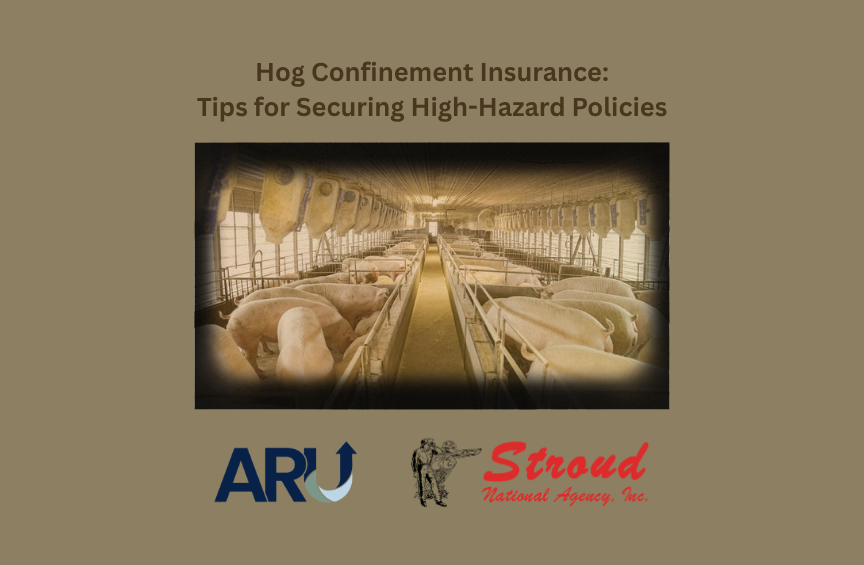
Hog confinement operations are some of the most specialized risks in agriculture, and gaps are common in hog confinement insurance submissions.
At first glance, these accounts may look like a standard livestock operation, but in reality, modern hog confinement facilities depend on tightly controlled systems, specialized equipment, and complex operational relationships that create exposures far beyond a typical farm policy.
For agents, understanding the basics of hog confinement insurance is critical to building the right coverage and avoiding costly gaps.
Why Hog Confinement Risks Are Different
Unlike traditional open-lot livestock operations, confinement barns rely almost entirely on controlled environments.
Ventilation systems, temperature controls, feed delivery systems, water systems, alarms, and backup power all have to function continuously.
If one critical system fails, losses can escalate quickly, especially during extreme weather.
A power outage or ventilation failure in extreme hot or cold temperatures can lead to catastrophic livestock mortality in a matter of minutes. In many cases, a single event can impact:
- Livestock
- Buildings
- Equipment
- Business income
- Contract obligations
- Environmental liability
Common Coverage Challenges
One of the biggest mistakes agents make is treating confinement barns like ordinary farm outbuildings.
Underwriters need far more detail than simply “Hog barn – $X value.” They want to understand:
- Type of operation (farrowing, nursery, finishing, etc.)
- Number of animals
- Barn construction, dimensions, location details, and age
- Ventilation and heating systems
- Generator and backup power setup
- Alarm and monitoring systems
- Manure handling procedures
- Loss details
- Integrator contract details
Without those details, underwriters are often forced to guess at the exposure, which can lead to delays, restrictive terms, or outright declines.
Equipment Dependency Creates Unique Risks
Standard property or livestock forms often limit or exclude losses related to mechanical breakdown, but modern hog confinement operations are highly dependent on specialized mechanical systems.
That’s why agents need to carefully review endorsements, exclusions, and coverage triggers instead of assuming livestock losses are automatically covered.
Environmental Liability Is a Major Exposure
Hog confinement operations also create meaningful environmental exposures as manure pits, lagoons, and land application systems can introduce pollution concerns that may not be adequately addressed under standard farm liability forms.
Depending on the operation, hog farm insurance may need to address:
- Manure spills
- Groundwater contamination
- Runoff events
- Regulatory cleanup costs
Contracts Matter More Than Many Agents Realize
Many hog confinement operations operate under contracts with integrators, lenders, or landlords that require:
- Specific liability limits
- Named insured requirements
- Additional insured status
- Specialized livestock coverage
- Evidence of environmental protection
It’s important to review these agreements carefully before placing coverage, because an insurance policy may technically be in force but still fail to meet contractual obligations.
What Underwriters Want to See
A strong hog confinement insurance submission package tells the full story of the operation and includes:
- Type of operation and annual throughput
- Barn-by-barn schedules
- Construction details
- Equipment and generator information
- Ventilation and backup system details
- Biosecurity procedures
- 3-5 years of loss history
- Copies of integrator or lease agreements
- Updated replacement cost valuations
- Photos
The cleaner and more complete the submission, the easier it is for underwriters to understand the exposure and offer competitive terms.
Loss Control Matters
Underwriters also want evidence of strong operational management, such as:
- Generator testing procedures
- Alarm response protocols
- Ventilation maintenance schedules
- Staff training
- Biosecurity controls
- Veterinary relationships
- Structural maintenance and inspections
Good documentation demonstrates that the operation takes risk management seriously, which can improve underwriting outcomes.
Work With Stroud on Hog Confinement Insurance
Given the complexities involved, hog confinement is often out of appetite for many markets, or considered only as an incidental exposure in a broader farm policy.
Luckily, Stroud partners with ARU, a non-admitted market that understands hog confinement risks and finds ways to offer coverage on everyday operations. ARU often leverages proactive loss control as a means to improve an operation’s overall risk profile.
If you’re working on a hog confinement account and want guidance on placement, underwriting expectations, or submission strategy, the Stroud Crowd is here to help. Get started with a quote, or contact us at 800-654-4056 to discuss coverage for your clients.